
African American History Carter G. Woodson Harvard Phd Associated Publishers DC
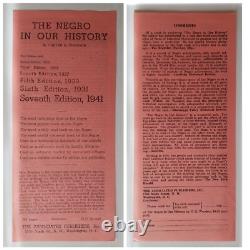
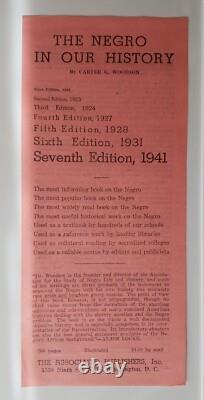
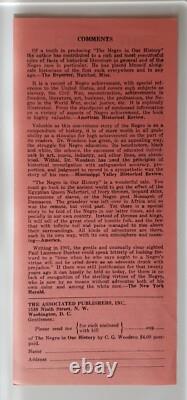
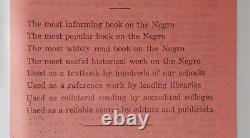
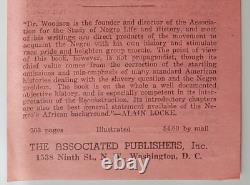

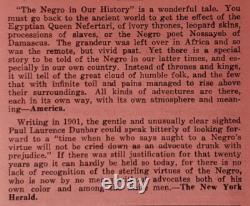

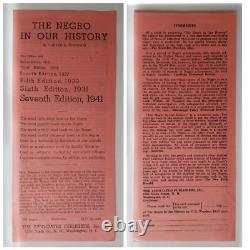

An original rare 1941 pamphlet measuring approximately 9 x 4 inches. Woodson was a scholar whose dedication to celebrating the historic contributions of Black people led to the establishment of Black History Month, marked every February since 1976. Woodson fervently believed that Black people should be proud of their heritage and all Americans should understand the largely overlooked achievements of Black Americans. Early years and education Woodson overcame early obstacles to become a prominent historian and author of several notable books on Black Americans. Born in 1875 to illiterate parents who were former slaves, Woodson's schooling was erratic.
He helped out on the family farm when he was a young boy and as a teen worked in the coal mines of West Virginia to help support his father's meager income. Hungry for education, he was largely self-taught and had mastered common school subjects by the age of 17.
Entering high school at the age of 20, Woodson completed his diploma in less than two years. Woodson worked as a teacher and a school principal before obtaining a bachelor's degree in literature from Berea College in Kentucky.
After graduating from college, he became a school supervisor in the Philippines and later traveled throughout Europe and Asia. In addition to earning a master's degree from the University of Chicago, he became the second Black American, after W. Du Bois, to obtain a Ph. He joined the faculty of Howard University, eventually serving as Dean of the College of Arts and Sciences. Black history ignored After being barred from attending American Historical Association conferences despite being a dues-paying member, Woodson believed that the white-dominated historical profession had little interest in Black history.
He saw African-American contributions overlooked, ignored, and even suppressed by the writers of history textbooks and the teachers who use them. For Black scholars to study and preserve Black history, Woodson realized he would have to create a separate institutional structure. With funding from several philanthropic foundations, Woodson founded theAssociation for the Study of N Life and Historyin 1915 in Chicago, describing its mission as the scientific study of the neglected aspects of N life and history.
The next year, he started the scholarlyJournal of N History, which is published to this day under the nameJournal of African American History. The Associated Publisherswas a producer of printed materials, founded by historianCarter G Woodsonin June 1921.[1][2][3]The publishing company was founded to initially help Woodson produce his own works and helped many other scholars of black history deliver their works to the public. [4] After World War I, Woodson sensed a desire in the African-American community to know more about their past.
Because the major publishing companies at the time showed no interest for producing serious works on this topic, Woodson organized The Associated Publishers in November 1920. It was conceived as a funding resource for theAssociation for the Study of African American Life and History. [5] The company produced more than 200 books, covering wide swaths of African American life and history. Many were of a formal, footnoted nature, written by recognized authorities in historical scholarship.
The company published several collections of short stories, primarily for young readers, with an emphasis on important people and events. Other titles included poetry, drama, and athletic sports. The company published a variety of materials, including monographs, translations of the works of reputable foreign scholars, pictures, and even calendars.[6] The Associated Publishers closed its doors in 2005. Contributing authors and illustrators edit Source[8] Horace Mann Bond author Maud Cuney-Hare author W. Montague Cobb author Paul Laurence Dunbar author Lois Mailou Jones illustrator Robert T. Klingberg author Kelly Miller author James A. Porter illustrator Alrutheus Ambush Taylor, Ph.
Author Significant publications edit Some of the more significant publications that were produced between 1920 and 2005:[9][10] The Mis-Education of the N[11] The N in Our History. The History of the N Church, Dr. Woodson, 1921 The Everlasting Stain, Kelley Miller, 1924 N Orators and Their Orations, Dr. , 1926 N Makers of History, Dr. Woodson, 1928 African Myths Together with Proverbs, Dr.
Woodson, 1928 The N as a Businessman, Dr. Woodson, 1929 The Story of the N Retold, Dr.
Woodson, 1935 N Musicians and Their Musicby Maud Cuney-Hare, 1936 African Heroes and Heroines, Dr. Woodson, 1939 Richard Allen: An Apostle of Freedomby Charles Wesley, 1969 Robert S. Duncanson, 19th Century Black Romantic Painterby James Dallas Parks, 1980 Walking Proud: The Story of Dr. Carter Godwin Woodsonby Sister M. Anthony Scally, RSM, 1983 Source: Wikipedia.